


You built the smoothest onboarding flow in Europe. The app looks great. Documents upload in seconds. The automated ID check runs in under a minute. Yet your drop-off rate in Germany is painful to look at.
This is not a UX problem. It is a trust problem, and it is deeply rooted in who German banking customers are and what they have always valued.
Germany is not a country that moves fast and breaks things, especially when money is involved. German consumers tend to adopt digital financial services more slowly than consumers in other countries, driven by privacy concerns and trust issues. That is not a weakness in the market. It is a signal. And banks that read it correctly are winning.
This post breaks down exactly why automated onboarding makes German customers uncomfortable, what the data says about their expectations, and why human-led video verification is the bridge that turns hesitation into a completed account opening.
Why Germans Are Cautious About Full Automation in Banking
A Culture That Takes Financial Security Seriously
Germany is not anti-digital. Over 72% of all customer interactions in Germany and Austria in 2024 took place via mobile channels. Germans use banking apps. They check balances, transfer money, and pay bills digitally every day.
But using an app for a routine task is very different from handing your identity documents to a machine and trusting it to make high-stakes decisions about who you are.
With 64% of Germans concerned about the economic situation, the focus for any bank has to be on blending usability with affordability and trust. Notice that trust is not optional there. It sits alongside usability as a baseline requirement.
The Fear of Becoming a Fraud Victim
The security concern is not abstract. Germany lost €267 billion to cybercrime in 2024, more than any other European country, with nearly 70% of fraud losses originating on digital channels. German consumers know this. They read about it. They talk about it. And when a bank asks them to submit passport scans and face photos to a fully automated system, that awareness is sitting right at the front of their minds.
Approximately 29% of German respondents ranked having their identity stolen to open an account as a top fraud concern. Almost one in three people are thinking about identity theft the moment they start an onboarding flow. An algorithm cannot look someone in the eye and reassure them. A trained human agent can.
The Emotional Gap Digital Banking Has Created
Since 2011, the banking industry has invested more than $2.8 trillion in digital transformation. But there is a downside: relationships now feel transactional, not relational. Automated experiences, while convenient, often lack the human touch that builds long-term loyalty.
Accenture put it plainly: many banks are “functionally correct but emotionally devoid.” Germany, more than most markets, punishes emotionally devoid. 44% of German consumers who resist digital-only banking say they value the option of physical branch visits, and 23% harbour trust issues with digital-only banks.
These are not fringe opinions. They are majority and near-majority positions among German banking customers.
What German Regulation Has Always Understood
Regulators often get a reputation for being slow. But BaFin, Germany’s financial regulator, understood something about trust long before the industry caught up.
For the better part of the last decade, Video-Ident, has been the dominant way German financial institutions onboard customers remotely. While many other European regulators were more open to automated verification methods, German financial institutions took a different path, leaning heavily on live video interviews with human operators. This did not happen by accident. It caught on because BaFin’s original 2014 framework for remote customer identification emphasised human supervision and real-time verification.
BaFin was not simply creating compliance hurdles. It was codifying what German customers already believed: that identity verification is serious enough to involve a real person.
In Germany, video identification requirements include that identification can only be conducted by specially trained staff, must be conducted in real-time without interruptions, and must use end-to-end encrypted channels.
These rules exist because they work. They protect both the bank and the customer. And importantly, they align with what German customers already feel comfortable doing.
The Numbers Behind the Trust Gap
Here is where the story gets interesting for anyone building a business case internally.
Consumer comfort with AI has decreased 11 percentage points since 2024, and 51% of banking consumers worry about losing human connection. However, acceptance increases significantly when specific benefits are clearly explained.
Read that last part again. Acceptance increases when benefits are clearly explained. That is a human conversation, not a chatbot notification.
Video-Ident costs three to four times more than semi-automated solutions but earns approval from only 11% of customers who find purely automated approaches user-friendly. The cost advantage of automation evaporates if completion rates are low and customers abandon the process entirely. 87% of corporate customers surveyed said they have abandoned a banking application at least once due to friction in the process.
Low completion rates cost real money. Every dropped onboarding is a customer who went somewhere else.
How Human-Led Video Verification Solves This
It Looks Like Banking, Not a Chatbot
When a customer connects with a trained agent over a secure video call, the experience signals safety. They can see a real person. They can ask questions. The agent can guide them through the document check step by step. It is the digital equivalent of walking into a branch, except it is faster and available without travel.
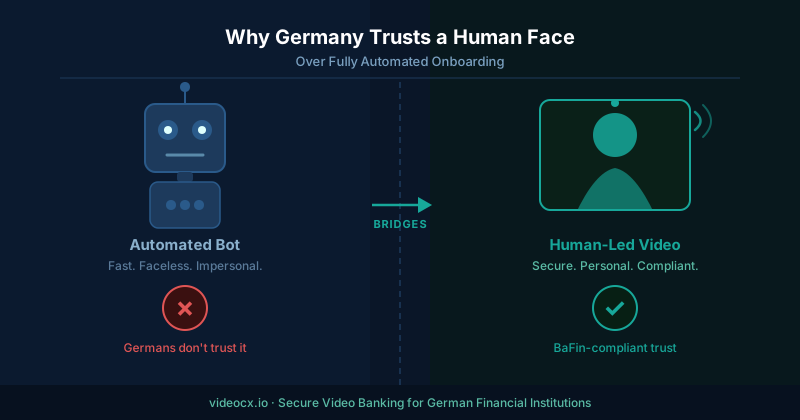
For German banks serious about secure, compliant remote verification, video-based identity verification replaces the cold, faceless automated flow with something that actually feels like a financial institution. That difference in perception has a direct impact on completion rates and customer satisfaction.
It Gives Customers Control
One of the core reasons Germans distrust automation is the feeling of handing over control. With a human agent on video, the customer can pause, ask what happens to their documents, confirm they are speaking to a real person, and feel heard. That sense of agency is not a small thing. It is often the difference between completing the process and closing the tab.
It Is Built for BaFin Compliance
Human-led video verification is not a workaround for regulation. It is what the regulation was designed to support. BaFin’s circular on video verification defines procedural requirements for live video verification, including consent, interaction standards, and verification steps. Germany has one of the most mature regulatory approaches to video-based customer identification.
Banks using compliant video branch and video banking infrastructure do not have to choose between regulation and customer experience. A well-built video session covers both at the same time.
It Extends Beyond Onboarding
The trust built during a video-assisted onboarding does not stop at account opening. The same infrastructure supports ongoing customer relationships. When a customer needs to discuss a credit application or verify their details for a new product, they already know what to expect.
For complex moments like credit verification and loan document review, having a trained agent available over video gives customers the confidence to move forward instead of abandoning the process mid-way through a decision.
This is also true for insurance customers. By implementing the benefits of live video sessions, banks and insurers can engage with customers at any time, organise face-to-face live interactions, and make the onboarding process more accessible while capturing essential documents under regulatory standards. For teams handling insurance policy servicing, video-assisted interaction reduces errors, builds customer confidence, and shortens resolution time.
The Practical Argument for German Banks
Let’s be direct about what this means for your operation.
German customers will eventually accept more automation. Approximately 46% of German consumers said they are more likely to open an account online than they were a year ago. The direction of travel is digital. But the pace of trust-building cannot be skipped.
Banks that try to force fully automated onboarding on a market that is not ready for it will face:
- High abandonment rates at the identity verification step
- Low net promoter scores among customers who do complete the flow
- Regulatory exposure if their automated checks do not meet BaFin’s procedural standards
- Reputational damage if a fraud event is linked to their automated onboarding
Banks that deploy human-led video verification as the primary channel, with automation handling the supporting steps, will see the opposite. Completion rates go up because customers feel safe. Trust transfers from the onboarding moment into the broader relationship. And compliance is built in by design, not bolted on after the fact.
The Bottom Line
Automated onboarding is not broken. For many markets and many use cases, it is the right answer. But Germany is not a market where you can skip the human layer and expect trust to follow automatically.
German customers have made their position clear through their behaviour, their survey responses, and the regulatory environment they have supported. They want to know there is a real person behind the process. They want to feel that their identity and their money are in careful hands.
Human-led video verification is not a compromise between convenience and trust. When it is built well, it delivers both. It is fast enough to compete with any automated flow, and it is human enough to earn the trust that closes the account opening, the loan application, and the insurance policy that a chatbot never could.
FAQ
Why do German banking customers distrust automated onboarding more than customers in other European countries?
Germany has a strong cultural emphasis on data privacy, financial security, and personal accountability. Decades of consumer behaviour have shown that German customers prefer human oversight in high-stakes decisions. Combined with the country’s leading fraud losses among European nations, this creates a baseline wariness toward systems where no one is visibly accountable.
Is video-based identity verification legally accepted in Germany?
Yes. BaFin has explicitly recognised video identification as a compliant method for remote customer verification since 2014. The framework specifies real-time interaction, trained staff, and encrypted channels. A properly built video verification flow meets all of these requirements.
Does adding a human agent slow down the onboarding process significantly?
Not when the infrastructure is designed well. A trained agent can complete an identity verification session in a few minutes. The time investment is small relative to the trust it builds, and it dramatically reduces abandonment at the verification step, which is the most common drop-off point in digital onboarding flows.
Can the same video infrastructure be used for post-onboarding customer service?
Yes, and it should be. The same platform that handles identity verification can support credit discussions, insurance queries, policy servicing, and relationship management. This is more cost-effective than running separate systems for onboarding and ongoing service.
Is video-led onboarding going to be replaced by fully automated flows as regulation evolves?
The EU’s new Anti-Money Laundering Regulation, coming into force by mid-2027, may open the door to more automated alternatives. But even as regulation evolves, the trust gap with German customers will persist for years. Banks that build strong video-first relationships now will be better positioned regardless of how the regulatory landscape shifts.